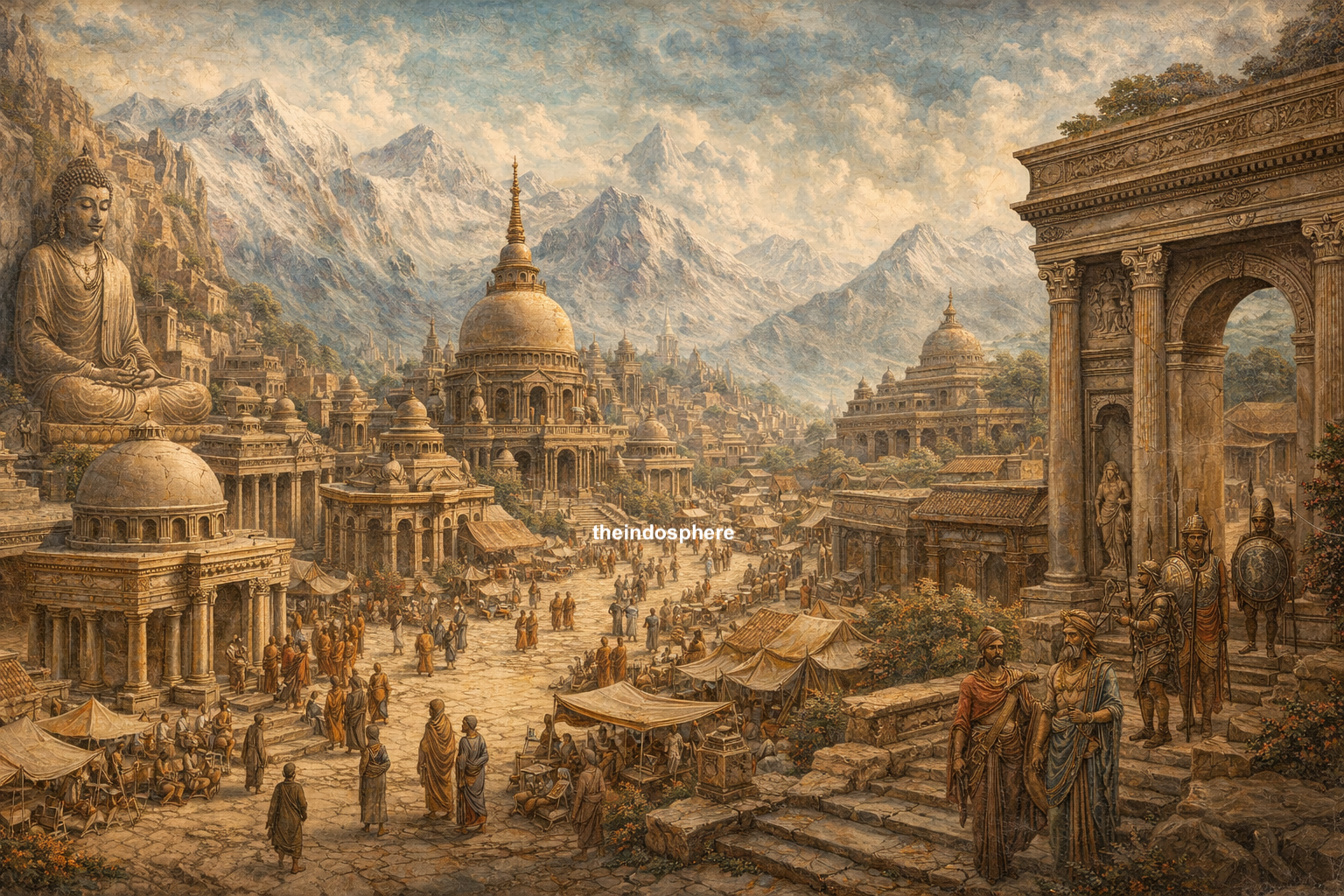
Gandhara occupies a unique place in the history of the Indian subcontinent and the greater Eurasian world. Nestled primarily in the Peshawar Valley and the regions around the Swat Valley, Taxila, and parts of modern-day northern Pakistan and eastern Afghanistan, Gandhara was not merely a territorial entity but a civilizational nexus where cultures, religions, and empires converged. For centuries, it acted as a geographical and intellectual bridge between South Asia, Central Asia, the Persian plateau, and the wider Hellenistic world. Its name evokes an era when it stood as a hub of trade, philosophy, art, and spiritual growth. Gandhara’s location along the great arteries of commerce and cultural interaction—the Silk Road and related networks—ensured its role as a mediator of ideas and goods, a true crossroads of civilizations.
The region’s history is not confined to a single epoch. It spans several thousand years, beginning with prehistoric settlements and extending into the medieval era. Its golden age under the Kushans, particularly during the reign of Kanishka in the first and second centuries CE, marked Gandhara as one of the most influential centers of Buddhist thought and art. The Gandharan school of sculpture, with its distinctive Greco-Buddhist synthesis, became a model that shaped Buddhist imagery across Asia. Yet Gandhara was never solely Buddhist; it absorbed Persian, Greek, Indian, Central Asian, and even Roman influences, testifying to the cosmopolitan character of its society.
Geography and Early History
The natural setting of Gandhara contributed greatly to its destiny. The Peshawar Valley, fertile and well-watered by tributaries of the Kabul River, formed the heart of Gandhara. To the north lay the Swat Valley, with its lush landscapes and strategic passes into Central Asia. To the east was Taxila, a city that would become synonymous with learning and cultural exchange. Gandhara was thus situated at a juncture between the Indian subcontinent and the highlands of Central Asia, while its western frontiers touched the Iranian plateau. This geography made it both vulnerable to invasions and uniquely positioned to benefit from trade.
Archaeological discoveries indicate that Gandhara was inhabited since prehistoric times. Stone tools, pottery fragments, and early agricultural evidence suggest human settlement long before the rise of urban civilization in the Indus Valley. As the Indus Valley Civilization waned around 1500 BCE, Indo-Aryan groups migrated into the region, bringing with them elements of Vedic culture. Gandhara is mentioned in the Rigveda and later Sanskrit texts, suggesting its integration into the cultural imagination of ancient India. By the first millennium BCE, Gandhara had developed as a region with urban centers, fortified towns, and connections to wider trade networks.
Its strategic passes such as the Khyber Pass allowed Gandhara to act as a gatekeeper. Whoever controlled Gandhara had access to both the riches of India and the routes to Central Asia. This duality shaped its destiny for centuries.
Achaemenid and Persian Influence (6th–4th century BCE)
The first major empire to incorporate Gandhara into its fold was the Achaemenid Persian Empire under Darius I in the late sixth century BCE. Inscriptions at Behistun and Persepolis mention Gandhara (referred to as “Gadāra”) as one of the satrapies under Persian rule. This integration brought Gandhara into a vast imperial system stretching from the Aegean to the Indus.
Persian rule left lasting legacies. The administrative practices of the Achaemenids introduced standardized coinage, taxation, and the use of Aramaic as an official script. The influence of Persian artistic styles can be seen in later Gandharan art, particularly in architectural motifs and reliefs. Persian connections also exposed Gandhara to Zoroastrian religious ideas, even though Buddhism and early Vedic traditions dominated the spiritual life of the region.
Most importantly, Persian control established the precedent that Gandhara was not isolated but part of larger political and cultural worlds. This openness would define its subsequent history.
Alexander the Great and Hellenistic Impact (4th century BCE)
In 327 BCE, Alexander of Macedon marched into Gandhara as part of his conquest of the Persian Empire and the northwestern frontiers of India. The battles fought in this region, particularly against local rulers such as those of the Aspasioi and Assakenoi tribes in the Swat Valley, were fierce. Yet Alexander’s campaigns left behind more than military devastation they opened Gandhara to Greek influences that would later flourish under the Indo-Greek kingdoms.
Alexander’s brief rule was followed by the establishment of garrisons and Greek settlers, who mingled with local populations. Hellenistic urban planning, coinage, and artistic motifs began to influence Gandhara. Cities adopted Greek layouts, and the imagery on coins showed a fusion of local and Hellenistic iconography. Even though Alexander soon departed, his conquest marked Gandhara’s first direct encounter with the Greek world, paving the way for deeper cultural synthesis in the centuries to come.
Mauryan and Ashokan Legacy (3rd century BCE)
Following Alexander’s departure and the fragmentation of his empire, Gandhara came under the rule of the Mauryan Empire in the late fourth century BCE. Chandragupta Maurya incorporated the region into his expanding state, but it was under Ashoka the Great (r. 268–232 BCE) that Gandhara’s historical role took a profound turn.
Ashoka, after his conversion to Buddhism, made Gandhara one of the key centers for spreading the faith. His edicts at Shahbazgarhi and Mansehra, inscribed in Kharoshthi script, stand as some of the earliest tangible evidence of Buddhism in the region. These inscriptions emphasized dharma, non-violence, and moral governance, and they reveal Gandhara’s integration into Ashoka’s vision of a Buddhist empire.
Buddhism in Gandhara was not merely a religion but a catalyst for cultural transformation. Monasteries and stupas were built, serving both spiritual and educational purposes. Gandhara’s position along trade routes meant that Buddhist ideas radiated outward from here to Central Asia and beyond. Thus began Gandhara’s central role in the transmission of Buddhism across Asia.
Indo-Greek Kingdoms and Cultural Synthesis (2nd–1st century BCE)
After the decline of the Mauryans, Gandhara witnessed the rise of Indo-Greek rulers, who combined Greek and Indian traditions in unprecedented ways. Among the most famous was Menander I (Milinda), who reigned around the mid-second century BCE. Menander’s reign became immortalized in the Buddhist text Milindapanha (“Questions of Milinda”), which records philosophical dialogues between the king and the monk Nagasena. This work exemplifies the spirit of intellectual cross-pollination that defined Gandhara.
The Indo-Greeks minted coins with bilingual inscriptions Greek on one side and Kharoshthi or Brahmi on the other showing the linguistic diversity of the region. Their art displayed Greek deities alongside Indian symbols, reflecting a society at ease with cultural plurality. Greek influence enriched Gandharan traditions without overwhelming them, resulting in a balanced synthesis rather than domination.
This era demonstrated that Gandhara was not simply a passive recipient of external influences but an active agent in shaping hybrid cultural forms.
Kushan Empire and the Golden Age of Gandhara (1st–3rd century CE)
The zenith of Gandhara’s history came under the Kushan Empire, particularly during the reign of Kanishka (c. 127–150 CE). The Kushans, originally of Central Asian nomadic origin, established an empire that stretched from Central Asia through Gandhara into northern India. Gandhara, with its capital often located at Purushapura (modern Peshawar), became one of the empire’s most significant centers.
Kanishka’s reign was transformative. He was a great patron of Buddhism and convened the Fourth Buddhist Council, traditionally held in Kashmir, which systematized Buddhist texts. Gandhara became a flourishing hub of Buddhist scholarship, attracting monks and pilgrims from across Asia. Taxila, within Gandhara’s orbit, became synonymous with learning, comparable in prestige to Nalanda in later centuries.
Economically, the Kushans capitalized on Gandhara’s location along the Silk Road. Trade with Rome brought gold coins and luxury goods, while routes to China facilitated the exchange of silk, spices, and Buddhist texts. Gandhara’s prosperity during this period fostered monumental architecture, elaborate stupas, and above all, the flowering of Gandharan art.
Gandharan Art and Architecture
The art of Gandhara represents one of the most remarkable examples of cultural fusion in human history. Known as Greco-Buddhist art, it combined the naturalism and realism of Hellenistic sculpture with Buddhist religious themes. The result was a unique artistic tradition that profoundly influenced the visual language of Buddhism across Asia.
Sculptures from Gandhara portray the Buddha with distinctly Hellenistic features curly hair, draped robes reminiscent of Greek togas, and realistic body proportions. The shift from aniconic to iconic representation of the Buddha, where the Enlightened One was depicted in human form, is credited largely to Gandharan innovation. Prior to this, Buddhist art primarily used symbols such as the Bodhi tree, the wheel, or footprints to represent the Buddha.
Stupas and monasteries were also central to Gandharan architecture. Sites like Takht-i-Bahi and Butkara reveal complex monastic layouts with stupas, chapels, and living quarters. Reliefs on these stupas depicted scenes from the Buddha’s life, rendered with dramatic realism and narrative depth. These works not only served religious functions but also embodied the cosmopolitan spirit of Gandhara, drawing on diverse artistic traditions to create something distinct.
Silk Road and Trade Networks
Gandhara’s role as a commercial hub was as important as its artistic achievements. Positioned at the crossroads of the Silk Road, it facilitated the movement of goods, people, and ideas. Traders from India, Persia, China, and Rome all passed through Gandhara, leaving their mark on its society.
Buddhist monks often accompanied merchants, establishing monasteries along trade routes. These institutions provided spiritual support and safe lodging, further embedding Buddhism into the fabric of Eurasian commerce. Gandhara thus played a pivotal role in transmitting Buddhism to Central Asia, China, and eventually Korea and Japan. Chinese pilgrims such as Faxian and Xuanzang, centuries later, recorded their journeys through Gandhara, marveling at its monasteries and stupas, even when the region had already begun to decline.
Trade also brought wealth, allowing Gandhara to commission large-scale artistic projects and sustain centers of learning like Taxila. Its economy, based on agriculture, crafts, and commerce, was deeply tied to the prosperity of the Silk Road.
Decline of Gandhara
Despite its flourishing, Gandhara was not immune to the tides of history. By the fourth and fifth centuries CE, the region faced increasing incursions from nomadic groups such as the White Huns (Hephthalites). Their invasions devastated Buddhist institutions, destroyed stupas, and disrupted trade networks. The decline of the Kushan Empire further weakened Gandhara’s central role.
Additionally, as trade routes shifted and maritime commerce grew in importance, Gandhara’s strategic advantage diminished. Buddhism gradually waned in the region, supplanted by Hindu traditions and, later, the spread of Islam in the early medieval period. By the eleventh century, Gandhara’s once-great monasteries lay in ruins, and its vibrant civilization had faded into memory.
Legacy of Gandhara Civilization
Although Gandhara declined, its legacy endured across Asia. The artistic innovations of Gandhara traveled with Buddhism into Central Asia, China, Korea, and Japan, shaping Buddhist iconography for centuries. The serene images of the Buddha, the elaborate stupas, and the narrative reliefs of Gandhara became templates for visual culture far beyond its borders.
In modern times, archaeological rediscoveries in the nineteenth and twentieth centuries revived interest in Gandhara. Excavations at Taxila, Peshawar, and Swat unearthed treasures of Gandharan art, now housed in museums worldwide. Scholars recognized Gandhara’s role as a linchpin in cultural and religious exchanges, highlighting its cosmopolitan identity.
Where the mountains of the Hindu Kush descend toward the fertile valleys of the Indus, a civilization once flourished that embodied the meeting of worlds. Gandhāra a land celebrated in the Mahābhārata, admired by Greek historians, and venerated by Buddhist pilgrims stood for centuries as a cultural frontier where India, Central Asia, and the Hellenistic West converged.
Gandhara’s story is one of encounters and transformations. Its geography made it a natural crossroads, and its history reflects the ebb and flow of empires, religions, and trade. From the Persians to the Greeks, from Ashoka’s Mauryan state to the Kushan Empire, Gandhara absorbed influences and gave back innovations that shaped the wider world. Its art fused Greek realism with Buddhist spirituality; its monasteries became beacons of learning; its merchants and monks carried ideas across continents. Even in decline, Gandhara left a legacy that resonates in Buddhist temples across Asia and in the annals of global history.